Anthropic Defies Pentagon as AI Labs Race to India and Alphabet Bets $185B
A high-stakes standoff between Anthropic and the U.S. Defense Department over AI safeguards is forcing rival labs to choose sides, while a tense AI summit in India and Alphabet's historic infrastructure pledge reshape the global AI landscape.
Pentagon-Anthropic Standoff Over AI Guardrails Puts Other Labs in a Bind
A simmering dispute between Anthropic and the U.S. Department of Defense has escalated into a full-blown standoff, with Defense Secretary Pete Hegseth reportedly close to designating Anthropic a "supply chain risk" — a move that would force any company doing business with the military to cut ties with the Claude maker. The conflict centers on Anthropic's refusal to allow two categories of use: mass domestic surveillance and fully autonomous weapons systems. The Pentagon, which signed a contract valued up to $200 million with Anthropic last year, is pushing all leading AI labs to make their models available for "all lawful purposes," including the most sensitive defense and intelligence operations.
The dispute took on a geopolitical dimension after reports emerged that Anthropic products were used in the operation to capture Venezuelan President Nicolás Maduro, accelerating tensions between the company and the Department of War — as it has been rebranded under the current administration. Anthropic says it is prepared to loosen some restrictions but insists its tools must never be used to fire weapons without human oversight or to surveil Americans in bulk.
The standoff is now putting competing labs in a difficult position. OpenAI, Google, and xAI have already lifted their standard safeguards under their own Pentagon agreements, and the Pentagon's ultimatum is being read as a pressure campaign to force the entire AI industry to abandon safety restrictions on government contracts. The outcome could set a defining precedent for how AI companies balance national security demands against their own ethical commitments.

Altman and Amodei Refuse to Hold Hands at India AI Summit, Telegraphing AI's Deepening Rivalry
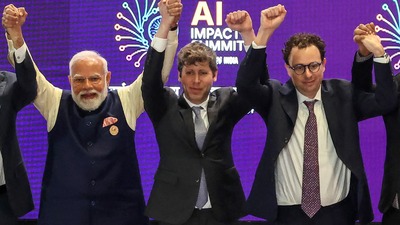
At India's AI Impact Summit on February 19, OpenAI CEO Sam Altman and Anthropic CEO Dario Amodei made headlines not for what they announced but for what they refused to do: stand unified. The two executives appeared alongside Indian Prime Minister Narendra Modi and Google CEO Sundar Pichai but raised fists instead of holding hands — a small gesture that captured the widening rift between the two companies that had previously shared founders and a common safety-first mission.
The optics came just weeks after the two companies battled each other in Super Bowl ads, with Anthropic's ad directly taking aim at OpenAI's decision to introduce advertising into ChatGPT. Anthropic reported an 11% jump in daily active users following its Super Bowl spot, while separately closing a $30 billion funding round that valued the company at $380 billion — more than double its valuation from just five months prior.
Beyond the theater, the India summit underscored the growing geopolitical importance of AI. Both companies are competing for international partnerships and government contracts as democracies worldwide race to establish AI infrastructure. The event also highlighted the contrast in the two companies' approaches: OpenAI has moved aggressively into defense and consumer monetization, while Anthropic continues to publicly champion safety constraints even when they cost it contracts.
Alphabet Commits Up to $185 Billion to AI Infrastructure, More Than Doubling Last Year's Spend
Alphabet has announced plans to spend between $175 billion and $185 billion on capital expenditures in 2026, with the bulk of the investment directed at AI compute capacity and cloud infrastructure. The high end of that range would be more than double the $91 billion the company spent in 2025 and surpasses spending plans announced by any other tech giant — Meta's 2026 capex is forecast at up to $135 billion, while Amazon's is projected at roughly $147 billion.
The announcement was made during Alphabet's fourth-quarter 2025 earnings call, where the company also reported nearly 48% growth in cloud revenue year-over-year and a cloud backlog that more than doubled, reaching $240 billion. CEO Sundar Pichai acknowledged that even the record spending might not be sufficient to keep pace with soaring demand, noting persistent supply constraints on AI hardware. Approximately 60% of the planned capex will go toward servers, with the remaining 40% covering data centers and networking.
The investment signals how central AI has become to Alphabet's long-term strategy and intensifies the infrastructure arms race among hyperscalers. Industry analysts note that the scale of these commitments is locking in competitive dynamics for years: companies that secure compute capacity now will have a structural advantage as AI demand accelerates. For smaller AI labs and startups, the spending gap between big tech and everyone else is becoming increasingly difficult to bridge.
What You Can Do
Read Anthropic's Usage Policy
Understand exactly where Anthropic draws the line on military and surveillance use — the policies at the center of the Pentagon dispute.
Track the AI Infrastructure Arms Race
Compare hyperscaler capex plans and understand how the infrastructure race will shape AI capabilities over the next several years.
Follow the Pentagon-Anthropic Story
This dispute could set a landmark precedent for how AI companies respond to government pressure on safety guardrails. Worth following closely.