Trump Delivers Record-Length State of the Union as Ukraine Marks Four Years of War
President Trump addressed Congress in the longest State of the Union on record, touting economic progress and outlining foreign policy priorities, as Ukraine and the world marked the somber four-year anniversary of Russia's full-scale invasion with no peace deal in sight.
Trump Delivers Longest State of the Union on Record, Announcing Retirement Plan and AI Energy Policy
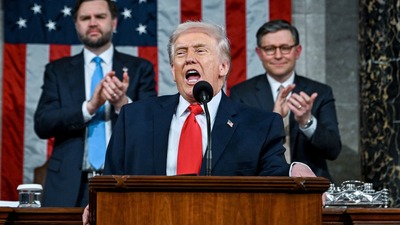
President Donald Trump addressed a joint session of Congress on the evening of February 24, 2026, delivering a State of the Union that surpassed the length of his own record-setting joint address from the prior year. Trump declared "we are winning so much," citing economic indicators including a reported drop in core inflation to its lowest level since April 2021 and an 18% rise in the S&P 500 during 2025. Among the policy announcements was a proposed new retirement savings program for workers lacking employer-sponsored plans, with a stated government match of up to $1,000 annually—details on funding or required Congressional action were not provided.
The president also announced what the White House described as "ratepayer protection pledges," under which technology companies building new data centers would agree to pay elevated electricity rates in host communities to offset grid cost impacts. On immigration, Trump described the southern border as the most secure in the nation's history. Independent fact-checks published by NPR, NBC News, and PBS NewsHour noted that Border Patrol migrant encounters have reached their lowest level in more than 50 years, while contesting several other specific claims in the address.
Virginia Governor Abigail Spanberger delivered the official Democratic response, arguing that cost-of-living pressures remain high for many American families more than a year into Trump's second term. Spanberger cited what she characterized as the negative consumer impact of the administration's tariff policies and criticized the methods being used in immigration enforcement. On foreign policy, Trump stated his administration is actively working to end the Russia-Ukraine conflict, while warning that Iran would "never" be permitted to acquire a nuclear weapon, with two U.S. aircraft carriers currently deployed to the Middle East.
Ukraine Marks Four Years of War as Peace Negotiations Stall and Europe Reaffirms Support
February 24, 2026 marked four years since Russia launched a full-scale invasion of Ukraine, an operation the Kremlin anticipated would conclude within days but that has extended into one of the most destructive European conflicts since World War II. Ukrainian President Volodymyr Zelenskyy declared that Russia had not "broken" Ukraine, and more than a dozen senior European officials traveled to Kyiv to mark the anniversary in a show of solidarity. The United Nations General Assembly passed a resolution reaffirming member states' commitment to Ukraine's sovereignty and territorial integrity, while the UN Security Council held a formal session dedicated to the conflict.
Casualty estimates compiled by the Center for Strategic and International Studies put combined total losses—killed and wounded—at approximately 1.2 million for Russia and up to 600,000 for Ukraine through December 2025, with an estimated 325,000 Russian deaths and up to 140,000 Ukrainian deaths over that period. The figures underscore the scale of the humanitarian toll after four years of continuous warfare.
Efforts to broker a ceasefire or peace agreement have not yielded a breakthrough. U.S. Secretary of State Marco Rubio acknowledged at the Munich Security Conference earlier this month that the United States "does not know if Russia really wants peace." Trilateral talks held in Geneva concluded after two hours with no public statement of progress. President Trump stated during his State of the Union address that his administration is "working hard" to end the conflict, but no specific framework or timeline was disclosed.

SAVE America Act Reaches Senate with 50 Votes but Faces Filibuster Barrier
The SAVE America Act—formally the Safeguard American Voter Eligibility Act—passed the House of Representatives on February 11, 2026, on a near party-line vote of 218-213, with Republicans voting unanimously in favor and nearly all Democrats opposed. The legislation would require individuals to present documentary proof of U.S. citizenship when registering to vote in federal elections, and a government-issued photo ID when casting a ballot.
In the Senate, the bill has secured the backing of 50 Republican members but falls short of the 60-vote threshold needed to advance past a Democratic filibuster under existing Senate rules. Republicans hold a 53-47 majority in the chamber, and at least three members—including Senators Lisa Murkowski of Alaska and Mitch McConnell of Kentucky—have not publicly committed their support for the measure. The Senate vote has not yet been scheduled as of February 24.
Proponents of the legislation argue the measure strengthens the integrity of federal elections by ensuring that only U.S. citizens participate. Critics, including the Brennan Center for Justice and the Campaign Legal Center, contend that noncitizen voting in federal elections is already prohibited by law, and that the documentation requirements could effectively disenfranchise millions of eligible citizens who do not possess a passport or readily accessible birth certificate. The debate over the bill is expected to continue as Congress works through the current legislative calendar.
What You Can Do
Read the Full SAVE America Act Text
Access the complete bill text and legislative history on Congress.gov to review the voter registration requirements firsthand.
Review Independent Fact-Checks of the State of the Union
NPR and NBC News published detailed, annotated fact-checks of the president's economic, immigration, and foreign policy claims.
This content aims for factual reporting. SuperPage does not endorse any candidates, parties, or political positions.