Oil Tops $110 as Dow Futures Plunge 1,000 Points — Iran War Sends Markets to the Brink
Crude oil broke above $100 per barrel for the first time since 2022 as Iran's closure of the Strait of Hormuz deepened, sending Dow futures into freefall over the weekend while stagflation fears mounted amid weak jobs data and a new 15% global tariff.
Oil Crosses $100 a Barrel, Dow Futures Plunge Over 1,000 Points as Iran War Intensifies
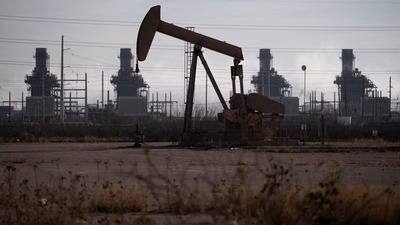
Crude oil prices crossed the $100-per-barrel threshold for the first time since Russia's 2022 invasion of Ukraine on Sunday, March 8, as the second week of the U.S.-Israel conflict with Iran showed no signs of resolution. West Texas Intermediate crude surged 24.6% to $113.30 a barrel and Brent crude gained 23.4% to reach $114.38, driven by Iran's continued closure of the Strait of Hormuz — a critical chokepoint through which nearly a fifth of global crude oil and natural gas supply typically flows, according to reporting from Fortune and CNBC.
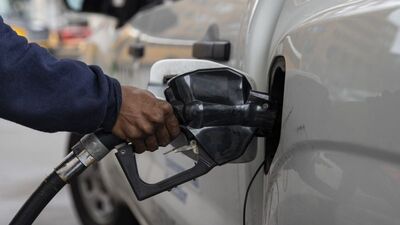
U.S. stock futures reacted sharply to the weekend developments. Dow Jones futures fell more than 1,000 points at their worst levels on Sunday evening before paring to a decline of 768 points (1.62%) by early Monday morning, according to CNBC. S&P 500 futures dropped 1.52% and Nasdaq 100 futures fell 1.55%. On the consumer side, the national average price of gasoline climbed to $3.45 per gallon — a 16% jump from the prior week — heightening concerns about renewed consumer inflation.
The war's geographic footprint continued to widen. The U.S. ordered non-emergency government personnel to leave Saudi Arabia as the conflict threatened broader Gulf stability, CNN Business reported. President Donald Trump signaled no immediate plan to release oil from the Strategic Petroleum Reserve to ease the price pressure, leaving energy markets on edge heading into Monday's trading session.
Dow Posts Worst Week in Nearly a Year as Oil Logs Biggest Weekly Gain in Futures History
U.S. equity markets closed the week ending March 7 with steep losses across the board. The Dow Jones Industrial Average shed roughly 3% for the week, with Friday's session alone seeing a 453-point (0.94%) decline to close at 47,502. The S&P 500 dropped approximately 2% for the week — erasing all year-to-date gains and turning negative for 2026 — while the Nasdaq Composite fell about 1.2%, according to data reported by Yahoo Finance and CNBC.
Energy markets drove the chaos. West Texas Intermediate crude oil posted a weekly gain of 35.63% — the largest single-week advance in the history of oil futures contracts, a record dating back to 1983, according to CNBC. The surge was fueled entirely by the Iran conflict's threat to global crude supply chains and mounting uncertainty about how long the Strait of Hormuz would remain blocked.
Friday's session was particularly bruising, as the Labor Department released its February employment report showing a contraction of 92,000 nonfarm payrolls — a surprise decline compared to economist expectations of a 50,000 gain, according to Schwab. The unemployment rate rose to 4.4% from 4.3%, deepening concerns that the labor market may be weakening precisely as energy-driven inflation picks back up.
Stagflation Fears Mount as 15% Global Tariff Takes Effect and Energy Costs Squeeze Corporate Margins
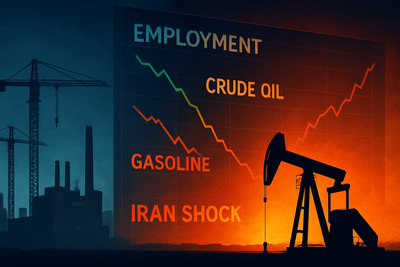
Wall Street is confronting an economic threat not seen since the 1970s: stagflation — the toxic combination of slowing economic growth and rising inflation. The convergence of a historic energy price shock, a contracting labor market, and a 15% universal global tariff signed into effect on February 24 has analysts warning that the conditions that powered the 2024–2025 bull market may have fundamentally shifted, according to FinancialContent's MarketMinute. The tariff, imposed by the Trump administration under Section 122 of the Trade Act of 1974, was expected to have an immediate pass-through effect on domestic consumer prices.
Major corporations have begun quantifying the damage. General Motors warned that operating costs in 2026 could swell by up to $4 billion as a direct result of the tariff's full-year implementation, according to FinancialContent. Walmart disclosed in its February 2026 quarterly report that its inventory buffers against tariff-driven cost increases had been depleted, leading to an immediate 3% price hike on general merchandise. Nike and Levi Strauss have similarly disclosed that roughly 90% of new tariff costs are being passed through to domestic operations.
The dual shock of higher energy prices and trade barriers has put the Federal Reserve in a difficult position. With inflation risks rising at the same time that payrolls contracted by 92,000 in February, policymakers face a narrower window for adjustment. Treasury Secretary Scott Bessent indicated the 15% global tariff was expected to remain in force in the near term, leaving both markets and businesses to adapt to a more restrictive global trade environment.
What You Can Do
Track Real-Time Oil Prices
Monitor WTI and Brent crude futures prices live to follow the energy market's impact on stocks.
View Recent SEC Filings
Access the latest 8-K and 10-Q filings for companies disclosing tariff and energy cost impacts.
Read the February Jobs Report
The Bureau of Labor Statistics official release with the full payroll and unemployment data.
This content is for informational purposes only and does not constitute financial advice. Consult a qualified financial advisor before making investment decisions.