Trump Delivers Record-Length State of the Union as Iran Nuclear Talks Conclude Without Deal
President Trump addressed Congress in a nearly two-hour speech touting a "golden age" for America, while U.S.-Iran nuclear negotiations in Geneva concluded their third round without an agreement, and Anthropic publicly rejected the Pentagon's demand for unrestricted AI access.
Trump Delivers Longest-Ever State of the Union, Declaring a 'Golden Age' for America
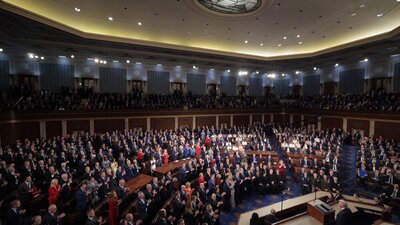
President Trump addressed a joint session of Congress on February 25, 2026, in a speech lasting approximately 108 minutes — setting a new record for the longest spoken State of the Union address. Speaking from the House chamber, Trump described the United States as entering a "golden age," emphasizing progress on border security, manufacturing growth, and economic conditions under his administration.
The president highlighted what he called the "most secure border in American history," citing reductions in illegal crossings and fentanyl trafficking. Trump also proposed new economic initiatives, including a government-backed retirement savings program for workers without employer-matched plans, and announced a "Rate Payer Protection Pledge" intended to require technology companies to supply their own power for AI data centers. Several Democratic lawmakers interrupted the speech; Representative Al Green was escorted from the chamber after displaying a sign, while other members called out during Trump's remarks.
Multiple news organizations assessed Trump's economic claims against independent data, noting that public polling shows cost-of-living and inflation remain top concerns for many Americans, with critics linking some price pressures to the administration's tariff policies. Democratic leaders offered a formal rebuttal after the address, contesting several assertions made during the speech.
U.S. and Iran Complete Third Round of Indirect Nuclear Talks in Geneva Without a Deal
U.S. and Iranian negotiators concluded their third round of indirect nuclear talks in Geneva on February 26, 2026, without announcing a formal agreement. The two countries' delegations engaged in hours of mediated negotiations, with Iranian Foreign Minister Abbas Araghchi describing the session as the "longest, most serious" round of discussions to date.
The parties identified core areas of contention: the United States is pressing for restrictions on Iran's uranium enrichment and long-term verification mechanisms, while Iran insists its enrichment program remain within its borders under International Atomic Energy Agency (IAEA) oversight. Iran's foreign minister said Tehran affirms it will not pursue nuclear weapons and described progress in narrowing the gap between the two sides' positions. The Trump administration also issued new sanctions on 30 individuals ahead of the talks, targeting those accused of enabling Iranian oil sales and weapons production.
Following the Geneva session, both sides agreed to convene technical teams in Vienna at IAEA headquarters to work through the details of a potential framework. The negotiations are taking place against a backdrop of a significant U.S. military build-up in the Middle East, with Vice President Vance stating the U.S. has observed evidence of Iran attempting to rebuild nuclear weapons capability.

Anthropic Rejects Pentagon's 'Final Offer,' Escalating AI Access Standoff
Artificial intelligence company Anthropic publicly rejected what the Pentagon described as its "final offer" on February 26, 2026, intensifying a dispute over the military's demand for unrestricted access to the company's AI systems. CEO Dario Amodei stated he "cannot in good conscience" accept the Department of Defense's terms, which would grant the military full, unfiltered control over Anthropic's Claude AI model for all lawful military purposes without usage restrictions.
The conflict stems from a $200 million defense contract awarded to Anthropic in July. Defense Secretary Pete Hegseth set a Friday deadline for compliance and threatened to cancel the contract and designate Anthropic a "supply chain risk" if the company did not comply. The Pentagon began laying groundwork for potential consequences, asking major defense contractors including Boeing and Lockheed Martin to assess their operational exposure to Anthropic's technology.
Anthropichas expressed concern that unrestricted military use could extend to AI-powered surveillance of American citizens or autonomous weapons systems. The company offered limited concessions, including permitting its AI for missile defense applications, but rejected the broader demand for unlimited access. As of February 26, a Pentagon deadline remained set for the following day, with officials considering whether to invoke the Defense Production Act to compel compliance.

Qué Puedes Hacer
Watch the State of the Union Address
Access the full video and text of President Trump's 2026 State of the Union address via PBS NewsHour.
Follow U.S.-Iran Nuclear Talks
Track ongoing developments in the nuclear negotiations via Al Jazeera's live coverage and NPR's reporting.
Este contenido busca un reportaje objetivo. SuperPage no respalda ningún candidato, partido o posición política.