DHS Shutdown Continues as Democrats Demand ICE Reforms
A partial government shutdown of the Department of Homeland Security entered its third day while Secretary of State Rubio attempted to ease tensions with European allies at the Munich Security Conference.
Homeland Security Shutdown Drags On Over Immigration Enforcement Dispute
The Department of Homeland Security remained partially shut down for a third day on February 15 after negotiations between congressional Democrats and the White House stalled over demands for new restrictions on federal immigration agents. The shutdown began on February 14 following Democratic demands for reforms to Immigration and Customs Enforcement operations after two U.S. citizens were fatally shot by immigration officers in Minneapolis in January.
Democrats sent a list of ten demands to Republican congressional leaders, including requirements that ICE agents wear body cameras, display visible identification, obtain judicial warrants before entering private homes, and end racial profiling. They also called for banning agents from wearing masks to conceal their identities and stopping enforcement operations at sensitive locations like schools and churches. White House border czar Tom Homan dismissed these demands as "unreasonable" during an appearance on CBS News' "Face the Nation," arguing that agents need masks for protection and denying that ICE engages in racial profiling.
Despite the funding lapse, approximately ninety percent of DHS employees continued working without pay, and immigration enforcement operations proceeded largely unaffected. This is because the tax and spending legislation passed in 2025 provided DHS with one hundred seventy billion dollars in funding, including seventy-five billion specifically for ICE, giving the administration substantial resources to continue operations even without new appropriations. Congress remains on recess until February 23, with both parties entrenched in their positions.
Secretary of State Rubio Seeks to Reassure European Allies at Munich Conference
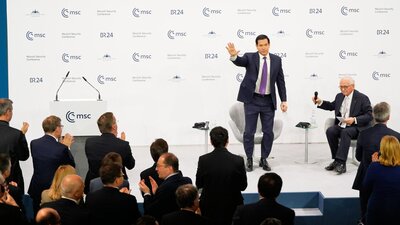
U.S. Secretary of State Marco Rubio delivered a speech at the Munich Security Conference on February 14 aimed at easing tensions with European allies, calling the United States the "child of Europe" and declaring that America and Europe "belong together." The address came at a critical moment for transatlantic relations, with many European leaders concerned about the direction of U.S. foreign policy under the Trump administration.
While Rubio's tone was notably more conciliatory than previous statements from administration officials, he maintained core policy positions, including demands that European nations assume greater responsibility for their own security and change course on immigration and trade policies. Rubio criticized what he characterized as Europe's embrace of open borders and mass migration, echoing administration rhetoric that these policies threaten Western civilization. European Union Commission President Ursula von der Leyen responded positively to the speech, stating she was "very much reassured" by Rubio's commitment to a strong Europe within the NATO alliance.
On the sidelines of the conference, Rubio held meetings with Ukrainian President Volodymyr Zelensky, stating that President Trump seeks a solution to end the conflict in Ukraine, and with Chinese Foreign Minister Wang Yi in talks the State Department described as "positive and constructive." The conference, held February thirteen through fifteen, served as a crucial forum for assessing the future of NATO and U.S.-European security cooperation during a period of significant uncertainty in the transatlantic relationship.
New START Nuclear Arms Treaty Expires, Ending Five Decades of Limits
The New START treaty between the United States and Russia officially expired on February 5, 2026, marking the first time in more than fifty years that no binding limits exist on the strategic nuclear arsenals of the world's two largest nuclear powers. The treaty, originally signed in 2010 and extended for five years in 2021, had limited both nations to a maximum of one thousand five hundred fifty deployed long-range nuclear warheads on delivery systems including intercontinental ballistic missiles, submarine-launched ballistic missiles, and bombers.
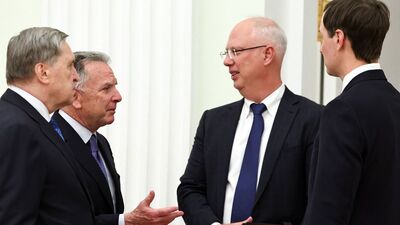
In September 2025, Russian President Vladimir Putin proposed that both countries continue observing the treaty's limits for an additional year until February 2027, provided the United States made a reciprocal commitment. However, Russia's Ministry of Foreign Affairs announced on February 4 that, in the absence of a formal U.S. response, Russia considered the treaty's obligations no longer binding. U.S. Secretary of State Marco Rubio has called for a new arms control agreement that would include China's participation, though Beijing has not expressed interest in such negotiations.
United Nations Secretary-General António Guterres warned that the treaty's expiration represents a "grave moment" for international peace and security, with binding constraints on nuclear weapons falling away during a period of heightened global tensions. Arms control experts note that the expiration removes verification mechanisms and transparency measures that had provided both sides with predictability regarding each other's nuclear capabilities, potentially increasing the risk of miscalculation and accelerating nuclear competition.
O Que Você Pode Fazer
Track Congressional Action on DHS Funding
Follow the latest updates on Department of Homeland Security appropriations and immigration reform negotiations when Congress returns from recess on February 23.
Read the Full Munich Security Conference Report
Access comprehensive coverage and analysis of the Munich Security Conference sessions, including speeches and panel discussions on transatlantic security challenges.
Learn About Nuclear Arms Control
Understand the history and significance of nuclear arms control treaties and what the expiration of New START means for global security.
Este conteúdo visa reportagem factual. SuperPage não endossa nenhum candidato, partido ou posição política.