DHS Shutdown Continues as Congress Remains Deadlocked Over Immigration Oversight
A partial government shutdown affecting the Department of Homeland Security entered its second day with no resolution in sight, while Secretary of State Rubio addressed European allies in Munich and a new federal workforce rule prepares to strip civil service protections from 50,000 employees.
Partial Government Shutdown Persists With No Clear Path to Resolution
A partial government shutdown affecting the Department of Homeland Security continued Saturday after Congress failed to agree on a funding measure before Friday's midnight deadline. The shutdown—the third in under a year—stems from a dispute over oversight of federal immigration enforcement agencies following the fatal shootings of two U.S. citizens, Alex Pretti and Renee Good, by federal officers in Minneapolis last month.
Democrats have conditioned their support for DHS funding on several oversight provisions: requiring immigration agents to wear active body cameras, display unique identification numbers, and obtain judicial warrants before making arrests on private property. Senate Minority Leader Chuck Schumer stated that Democrats are asking only that federal agents follow standards already observed by most local law enforcement agencies. Republicans and the White House rejected these conditions, with Border Czar Tom Homan saying the funding lapse would not halt immigration operations.
Congress is in recess until February 23, leaving the shutdown with no immediate legislative remedy. The DHS shutdown affects the Transportation Security Administration, FEMA disaster relief, and immigration services. Republican appropriators issued a statement blaming Democrats for the impasse, while Democrats said the Minneapolis shootings made accountability measures urgent.

Rubio Urges European Unity at Munich Security Conference Amid Transatlantic Tensions
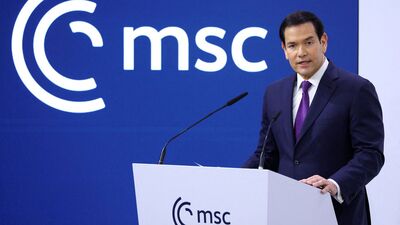
U.S. Secretary of State Marco Rubio addressed the 62nd Munich Security Conference on Saturday, delivering a message designed to reassure European allies of continued American commitment to the transatlantic alliance. Rubio declared that "the fate of Europe will never be irrelevant to our own" and received a standing ovation from much of the audience—a notably warmer reception than Vice President Vance received at the same forum in 2025.
Despite the diplomatic tone, Rubio made clear that the Trump administration is not adjusting its positions on migration, trade, or climate policy. He framed the alliance in terms of shared "Christian and cultural bonds," while European officials pushed back on that characterization. EU foreign policy chief Kaja Kallas, one of the few attendees who did not stand during the applause, stated: "Contrary to what some may say, woke decadent Europe is not facing civilizational erasure."
The conference also featured Ukrainian President Volodymyr Zelensky, who stated that Ukraine "needs a date" for EU accession and expressed hope for membership by 2027. Meanwhile, Chinese Foreign Minister Wang Yi used the Munich forum to signal Beijing's interest in deepening ties with European nations amid ongoing U.S.-China tensions.
New Rule Will Strip Civil Service Protections From 50,000 Federal Employees Next Month
The Office of Personnel Management finalized a rule establishing a new employment category called "Schedule Policy/Career"—previously known as Schedule F—that will remove civil service protections from an estimated 50,000 federal employees in positions deemed to be "policy-influencing." The rule takes effect March 8, 2026, thirty days after its publication in the Federal Register.
Under the rule, affected employees will lose their right to appeal adverse personnel decisions to the Merit Systems Protection Board and will be converted to at-will status. They will also be ineligible for student loan repayment assistance and certain recruitment and retention incentives previously available to career civil servants. The rule does not affect all federal workers—only those in senior or policy-adjacent roles across the executive branch.
Federal employee unions, including the American Federation of Government Employees and the American Federation of State, County and Municipal Employees, filed a lawsuit challenging the rule and are seeking a court order to block it before the March 8 effective date. Supporters of the rule argue it gives elected leadership greater accountability over the federal bureaucracy, while opponents contend it politicizes positions that have traditionally been insulated from partisan influence.

O Que Você Pode Fazer
Track the DHS Shutdown in Real Time
Follow live updates on the partial government shutdown, including its impact on TSA, FEMA, and immigration services.
Read the Schedule Policy/Career Final Rule
Access the official OPM rulemaking and learn how the civil service change affects federal employees.
Watch the Munich Security Conference Sessions
View recordings and summaries of key speeches, including Secretary Rubio's address and European leaders' responses.
Este conteúdo visa reportagem factual. SuperPage não endossa nenhum candidato, partido ou posição política.